
Journal Information
About Journal
About the Journal
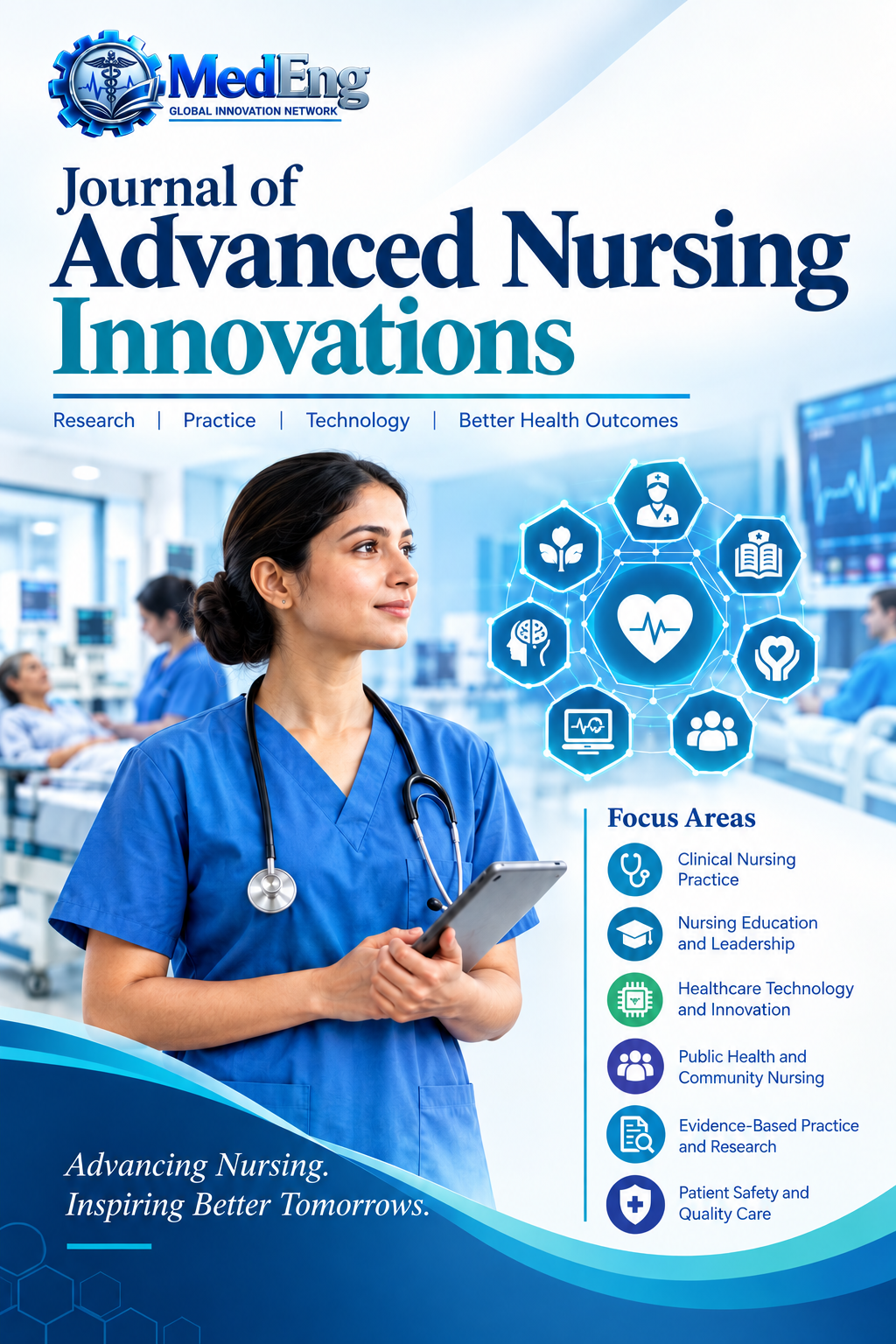
Journal of Advanced Nursing Innovations (JANI) is an international, peer-reviewed journal dedicated to promoting the advancement of nursing science, education, research, clinical practice, and healthcare innovation. The journal provides a scholarly platform for nurses, nursing educators, researchers, healthcare professionals, clinicians, and interdisciplinary practitioners to share original research, clinical experiences, evidence-based practices, innovative approaches, and emerging developments in nursing and healthcare.
The journal covers a broad range of nursing disciplines and healthcare areas, including medical-surgical nursing, critical care nursing, emergency nursing, community health nursing, maternal and child health nursing, pediatric nursing, psychiatric and mental health nursing, gerontological nursing, oncology nursing, cardiovascular nursing, public health nursing, nursing administration, nursing education, and advanced clinical nursing practice.
The journal also welcomes research focusing on evidence-based nursing practice, patient safety, healthcare quality improvement, nursing technology, digital health, telehealth, nursing informatics, clinical decision-making, healthcare innovation, nursing leadership, professional development, patient-centered care, health promotion, disease prevention, and interdisciplinary healthcare research.
Journal of Advanced Nursing Innovations publishes a wide range of scholarly contributions, including original research articles, review articles, systematic reviews, meta-analyses, clinical studies, case reports, case series, brief communications, methodological studies, educational research, and innovative practice reports.
Through a rigorous peer-review process and adherence to ethical publishing standards, the journal aims to promote scientific integrity, evidence-based nursing practice, innovation, professional collaboration, and the dissemination of reliable healthcare knowledge. The journal seeks to support the continuous development of nursing professionals and contribute to improved patient outcomes, healthcare quality, and the advancement of global nursing practice.
Articles can be submitted through online from https://medengpublications.com/online-submission/
or E-mail: nursing@medengpublication.org
Research Topics
Aims & Scope
Aim and Scope
Journal of Advanced Nursing Innovations (JANI) aims to publish high-quality, original, evidence-based, and clinically relevant research that advances knowledge, education, innovation, and professional practice in nursing and healthcare. The journal provides a platform for nurses, nursing researchers, educators, clinicians, healthcare professionals, and interdisciplinary researchers to communicate new scientific findings, clinical observations, innovative nursing practices, educational developments, healthcare technologies, and advances in patient-centered care.
The journal welcomes clinical, experimental, educational, translational, methodological, and interdisciplinary research that contributes to the advancement of nursing practice, healthcare delivery, patient safety, disease prevention, health promotion, clinical decision-making, and improved patient outcomes.
Journal of Advanced Nursing Innovations publishes original research articles, review articles, systematic reviews, meta-analyses, clinical studies, case reports, case series, brief communications, methodological research, educational research, and reports of innovative nursing practices.
The scope includes medical-surgical nursing, critical care nursing, emergency nursing, community health nursing, public health nursing, maternal and newborn nursing, pediatric nursing, gerontological nursing, oncology nursing, cardiovascular nursing, psychiatric and mental health nursing, perioperative nursing, rehabilitation nursing, palliative and hospice care, and advanced clinical nursing practice.
The journal also welcomes research in nursing education, nursing leadership, nursing administration, healthcare management, nursing workforce development, professional practice, evidence-based nursing, patient safety, quality improvement, infection prevention and control, clinical assessment, nursing interventions, health promotion, disease prevention, and patient-centered care.
Research addressing nursing informatics, digital health, telehealth, electronic health records, artificial intelligence in healthcare, healthcare technologies, clinical decision-support systems, simulation-based nursing education, and other technological innovations in nursing practice and education is also encouraged.
Articles can be submitted through online from https://medengpublications.com/online-submission/
or E-mail: nursing@medengpublication.org
Editorial Board
No editorial board members have been added for this journal yet.
Article In Press
Current Issue
Archive
Journal Guidelines
Manuscripts must be written in clear, correct, and unambiguous standard English. Papers that don’t adhere to these requirements won’t be accepted
The following components should be included in all manuscripts submitted to the journal for use as research and review articles:
Title page, Abstract, Keywords, List of Abbreviations (if any), Introduction, Materials and Methods or Experimental Procedures, Results, Discussion, Conclusion, Acknowledgments, Reference, Figures,
Tables
You may submit manuscripts online https://medengpublications.com/online-submission/
Title Page
The title should not use acronyms and should be no longer than 25 words. The main idea of the research findings should be reflected in the title.
Author Affiliations: All authors’ full names, affiliations, and contact information (including a telephone number, fax number, and email address) should be listed beneath the title.
Abstract
The abstract should be educational and entirely self-explanatory, providing a brief introduction to the subject, outlining the parameters of the experiment(s), and highlighting the importance of the study and key conclusions. In no more than 250 words, the abstract should provide a synopsis of the entire book. Abbreviations should be avoided, and standard terminology should be used instead. A description of the study’s background, methods, results, and conclusion should be included in the preferred format. The abstract should be followed by at least 5 to 6 keywords.
Text Introduction:
The opening should establish the tone of the document by clearly stating the study and the suggested strategy or fix. While outlining the significance of the study with appropriate references, the introduction should be sufficiently general to grab the reader’s interest.
Review of Literature:
All research, reviews, and case reports must include a thorough analysis of the relevant literature and emphasise to the reader how the study will advance the body of knowledge.
Materials and Methods:
A thorough summary of the study’s design should be provided in this part. To make the data more understandable for the readers, thorough descriptions of the research techniques used, the sample size, and the method of the experiment should be included. The data should also be presented in the form of tables, figures, images, etc.
Discussion:
To discuss the key findings from the study, a full statistical analysis of the data supplied using formulae, equations, etc. is necessary. This is a crucial component of the research that should yield the whole findings of the investigation.
Findings:
In order to establish or refute the claim made at the beginning of the study, this section presents the investigation’s key findings through comparisons, probability calculations, and testing of the ehypothesis.
Limitations, Conclusions, and Recommendations
The limits of the study, if any, as well as the sample size or methods used to conduct it, are listed by the authors after summarising the full investigation. The author(s) offers detailed suggestions on how to carry out further study in this field.
Funding The authors must acknowledge the funding agencies if any in their studies.
Acknowledgments: Author/s must acknowledge all the agencies,institutes, and individuals that supported the study in the end.
References
At the end of the manuscript, a list of all the references that were used in the text should be provided. The vancover agreement specifies how the references should be cited. The order in which they are first mentioned in the text should determine the order in which they are numbered. Arabic numerals [in square brackets] are used to identify references in the text. All sources that are cited must be verified by the authors. You must cite each author.
Fee Policy
Once an article has been accepted for publication, any article processing fees that were incurred to process the article are now due. MedEng Publications is an Open Access publications and the Article Processing Charges of USD $819 also once payment is processed, the journal will not issue refunds of any kind.
Submit Your Research
Submit your manuscript to MedEng Publications and share your research with the academic community.
Submit Online →